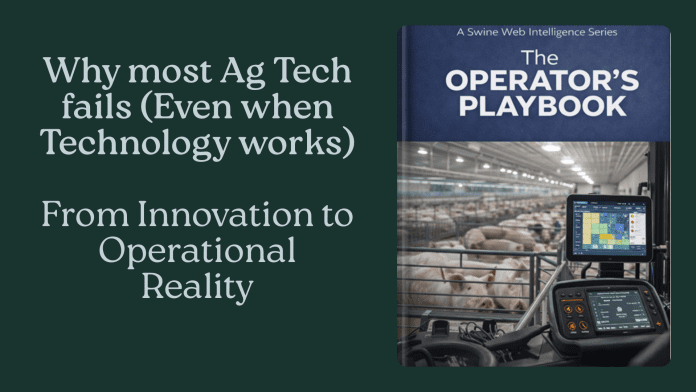
THE OPERATOR’S PLAYBOOK
A Swine Web Ag Tech & AI Intelligence Series
Calmer Operations. Better Decisions.
From Innovation to Operational Reality
Ag technology rarely fails because the software is bad.
It fails because it doesn’t survive the barn.
Most ag tech doesn’t fail in development.
It fails in daily use.
Across the industry, producers are surrounded by innovation — sensors, controllers, cameras, dashboards, AI models, and mobile platforms. On paper, many of these tools perform exactly as designed.
In practice, adoption slows. Pilots stall. Systems quietly get turned off.
Not because the technology failed…
but because it didn’t fit.
The Gap Between Innovation and Reality
The industry often celebrates what technology can do.
Operators focus on what they have to do.
That gap is where most ag tech breaks down.
Innovation is about capability.
Integration is about survival inside daily workflow.
And the barn is not a controlled environment.
It is:
- Time-constrained
- Labor-limited
- Physically demanding
- Constantly changing
Technology that works in ideal conditions often struggles in operational ones.
A Familiar Scenario
A new system gets installed.
The dashboard looks clean.
The data is flowing.
Alerts are configured.
For the first few weeks, everyone pays attention.
Then reality sets in.
- Alerts start coming at inconvenient times
- Data requires interpretation before action
- Staff begin relying on what they trust — instinct and routine
- The system becomes something you “check” instead of something you “use”
Nothing is broken.
But nothing changes either.
This is how most ag tech fails.
Quietly.
The Operator Filter
Producers don’t evaluate technology the way developers or investors do.
They apply a much simpler filter:
- Does this reduce uncertainty?
- Does this simplify decisions?
- Does it help on the worst day — not the best one?
If the answer isn’t clearly yes, the system doesn’t last.
Because in real operations, anything that adds friction gets removed — quickly or slowly.
More Data Doesn’t Equal More Value
Many platforms are built around data collection.
Operators are focused on problem resolution.
There’s a difference.
Dashboards, alerts, and reports can create the appearance of control.
But if they don’t lead to faster, clearer decisions, they create something else:
Noise.
When everything is flagged, nothing is prioritized.
When every alert matters, none of them do.
The result is decision fatigue — and eventually, disengagement.
Technology should reduce thinking load.
Not increase it.
The Hidden Cost of Complexity
Every new system introduces a layer of cost that isn’t always visible:
- Training time for staff
- Ongoing maintenance and troubleshooting
- Integration with existing systems
- Dependence on connectivity and uptime
- Cognitive load on the people actually running the barn
Operators feel these costs immediately — even if they’re not captured in ROI models.
And when complexity rises faster than value, adoption quietly declines.
Where Good Technology Breaks Down
Most ag tech doesn’t fail during setup.
It fails during pressure.
- When alarms stack during a health event
- When staff is short
- When conditions change quickly
- When decisions need to be made in minutes, not reviewed in dashboards
This is where systems are truly tested.
And this is where many fall short.
Because technology that requires interpretation slows response.
Technology that provides clarity accelerates it.
What Actually Works
The systems that stay in place — the ones that operators trust — tend to share a few characteristics:
- They fit into existing workflow instead of reshaping it
- They simplify decisions rather than expanding them
- They perform consistently under stress
- They require minimal explanation to use correctly
- They reduce variability in outcomes, not just increase visibility
They don’t try to impress.
They try to work.
Swine Web Perspective: From Technology to Utility
The conversation around ag tech is shifting.
It’s moving away from:
“What can this technology do?”
Toward:
“Does this make the operation run better?”
For North American producers, this shift is already underway.
Labor constraints, tighter margins, and increasing system complexity are forcing a more disciplined approach to technology adoption.
The winners will not be the operations with the most tools.
They will be the ones with the fewest points of friction.
The Bottom Line
Ag tech doesn’t fail because it lacks innovation.
It fails because it lacks alignment with reality.
The barn is the final test.
And the technologies that succeed will not be the most advanced…
They will be the ones that make operations calmer, decisions clearer, and outcomes repeatable.