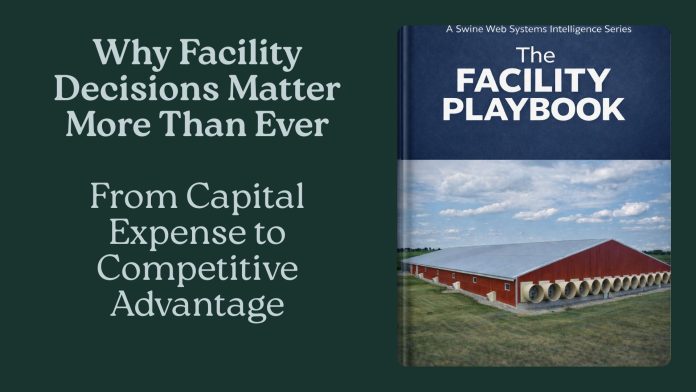
THE FACILITY PLAYBOOK
A Swine Web Systems Intelligence Series
Facilities used to be background decisions.
Concrete. Steel. Ventilation. Done.
Not anymore.
Today, your barn determines:
-
How many labor hours it takes to manage 2,400 head
-
How much propane you burn during a February cold snap
-
Whether airflow stabilizes during a PRRS break
-
Whether automation integrates cleanly — or requires workarounds
-
How easily you can retrofit new technology five years from now
A poor feed decision costs a cycle.
A poor facility decision locks in inefficiency for 20 years.
Infrastructure is no longer a construction expense.
It is a competitive position.
Your Facility Is Either Absorbing Pressure — Or Creating It
Modern commercial systems operate under constant stress:
-
Labor scarcity
-
Energy volatility
-
Welfare compliance scrutiny
-
Heightened biosecurity expectations
-
Continuous technology evolution
Facilities built under older assumptions now face structural pressure.
Labor efficiency is no longer just headcount.
It is steps per pig.
-
How far does a caregiver walk per day?
-
How many gates are moved during sorting?
-
How much time is lost navigating layout friction?
-
How many tasks require two people instead of one?
Design determines chore flow.
Flow determines labor demand.
Labor demand determines cost.
When labor tightens, design mistakes surface.
Ventilation Is Not Equipment — It Is System Architecture
Ventilation performance is rarely about fan horsepower alone.
It is about:
-
Inlet placement and adjustability
-
Static pressure stability
-
Insulation performance under humidity load
-
Air mixing during seasonal transitions
-
Electrical capacity for precision staging
When airflow cannot adapt:
-
Cold stress increases feed usage
-
Heat stress reduces intake
-
Health pressure amplifies
-
Medication costs rise
-
Performance variability widens
These are not catastrophic failures.
They are margin erosion.
And once the structure is poured, correction requires capital.
You cannot redesign airflow after concrete cures.
The Hidden Cost of “Lowest Bid” Thinking
Lowest bid reduces build cost.
It rarely reduces lifetime cost.
Facilities optimized for upfront savings often:
-
Limit equipment retrofits
-
Leave no electrical capacity for expansion
-
Increase labor movement per task
-
Lock in energy inefficiencies
-
Complicate sanitation and biosecurity flow
The construction invoice is visible.
Operational drag is not.
Drag looks like:
-
10–15 extra minutes per chore cycle
-
Additional barn entries during health events
-
Higher propane usage every winter
-
Equipment modifications to fit structural constraints
None of these break the system in year one.
All of them compound by year ten.
Real-World Pattern: Modernization Under Margin Pressure
Over the past several years, large U.S. integrators have invested heavily in facility modernization — not because their barns failed, but because margin pressure exposed structural limits.
In many cases, systems built 15–20 years ago were designed for:
-
Different energy cost assumptions
-
More available labor
-
Limited automation
-
Less sensor-driven management
As production became more data-intensive and labor-constrained, older infrastructure revealed friction points:
-
Environmental controls lacking real-time responsiveness
-
Electrical panels at capacity
-
Layouts that increased chore time
-
Ventilation systems without precision adaptability
Modernization efforts have focused on:
-
Precision climate control
-
Improved insulation envelopes
-
Expanded electrical capacity
-
Automation readiness
-
Layout optimization to reduce labor movement
The lesson is not that older barns were flawed.
It is that operational expectations changed.
When margins tighten, structural inefficiencies become measurable.
And raising a performance ceiling after construction is far more expensive than designing it correctly at the start.
Technology Cannot Fix Structural Rigidity
Producers are investing in:
-
Environmental monitoring
-
Precision feeding
-
Remote alarm systems
-
Automated sorting
-
Data integration platforms
But technology layered onto rigid infrastructure becomes workaround-driven.
If cable routing is limited…
If panel capacity is maxed out…
If pen design restricts equipment movement…
Automation creates friction instead of leverage.
Facilities must be designed for systems not yet purchased.
That requires foresight — not cost minimization.
Infrastructure Defines Competitive Ceiling
Facilities now influence:
-
Throughput consistency
-
Disease containment speed
-
Biosecurity execution
-
Energy exposure
-
Workforce sustainability
-
Margin resilience
In strong markets, inefficiency hides.
In tight markets, it surfaces.
Modern swine systems are no longer competing on genetics alone.
They are competing on architecture.
Takeaway
Facilities are not cost centers.
They are embedded operating systems.
They either:
-
Absorb variability
-
Or amplify it.
They either:
-
Create flexibility
-
Or enforce rigidity.
Infrastructure is no longer a capital line item.
It is a long-term performance multiplier.
Or a long-term constraint.
And constraints are expensive to demolish.