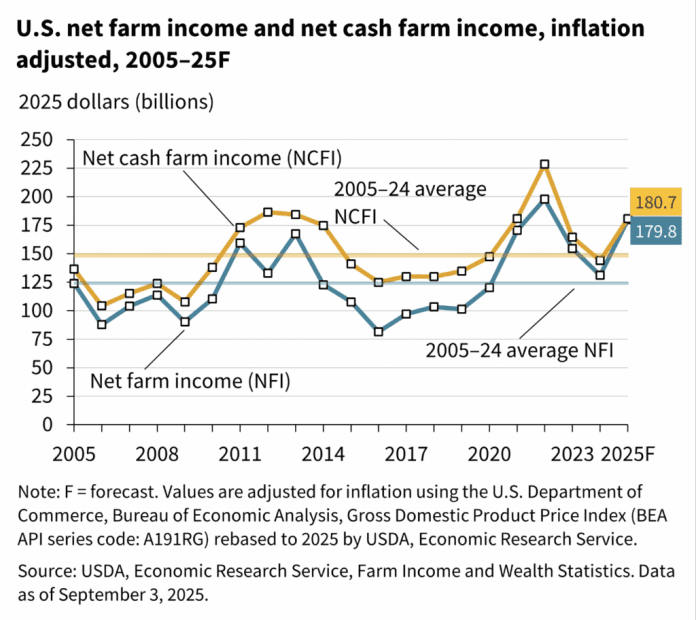
The USDA has trimmed its 2025 farm income outlook as falling crop revenues offset record earnings in the livestock sector, but the agency says total income levels remain well above 2024 thanks to strong government support and rising cattle prices.
The latest Economic Research Service (ERS) forecast projects net cash farm income at $180.7 billion for 2025 — a 25.3% increase over 2024 after inflation. That figure is down from February’s estimate of $193.7 billion but still well above the 20-year average, driven in part by $40.5 billion in government payments, the highest level since pandemic-era support in 2020.
Cattle Sector Shines While Crops Slip
USDA’s net farm income forecast — a broader measure that includes depreciation and inventory changes — now stands at $179.8 billion, up 37.2% over 2024. Gains in cattle earnings helped push profits higher even as lower crop returns trimmed earlier income estimates.
Congress allocated nearly $22 billion in disaster relief for 2023–24 losses, with $4.76 billion already paid to more than 329,000 farmers through the Supplemental Disaster Relief Program (SDRP). Conservation program payments also rose to $4.8 billion, a 10.3% increase from last year.
Rising Costs and Farm Debt Add Pressure
While income projections remain historically strong, production expenses are set to climb to $467.4 billion in 2025, up $12 billion (2.6%) from 2024. Labor costs alone have increased by $12 billion over the past three years, while livestock and poultry purchases surged 21.5% to $59.9 billion compared to 2024.
Farm debt also continues to rise, with total sector debt forecast at $591.8 billion, nearly 20% higher than in 2022. Interest expenses to service that debt are expected to hit $33.1 billion in 2025, up 16% since 2022 as elevated interest rates persist.
Outlook
Despite reduced forecasts compared to February, analysts say farm income remains well above long-term averages. For livestock producers — especially cattle operations — 2025 income levels are among the strongest in recent years, even as rising costs and higher debt levels loom large over the sector.