Rethinking the way trucks move across farm networks may hold the key to reducing the transmission of costly swine diseases. New modeling shows that strategic routing—supported by GPS data and farm health information—can make a measurable impact on biosecurity without requiring structural changes to barns or new technologies on-site.
Why Truck Routes Matter
-
Trucks link farms, feed mills, and processors across wide areas.
-
A vehicle leaving an infected site can carry PRRSV, PEDV, or other pathogens to healthy farms.
-
Even without animal movement, transportation alone can spread outbreaks.
Smarter Routing in Practice
The new approach evaluates truck movements and adjusts based on two core principles:
-
Avoid sending trucks directly from infected farms into healthy areas.
-
Increase the use of cleaning and disinfection (C&D) stations before moving into new communities.
Results show that:
-
Risky contacts drop by ~40% even if C&D is only moderately effective.
-
With strong C&D, disease spread is reduced even further.
-
Rerouting adds an extra layer of protection alongside barn-level biosecurity.
The Trade-Offs
-
Longer routes → higher mileage and fuel use.
-
More time → slower logistics and higher labor cost.
-
Increased wear → higher maintenance expense.
But the cost of extra mileage can be outweighed by preventing a single outbreak, which can cause millions in losses.
Implications for Producers
-
Stronger protection for sow farms and nurseries.
-
Reduced disruption across finishing sites.
-
Greater stability for packers and processors.
-
Opportunity to integrate routing software and health data for smarter logistics.
At a Glance
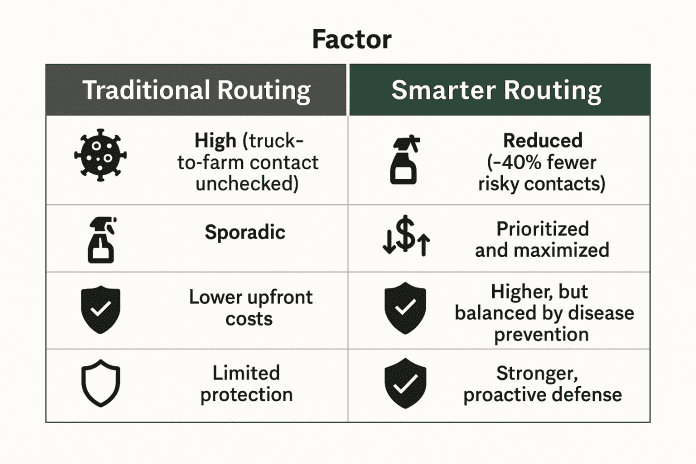
| Factor | Traditional Routing | Smarter Routing |
|---|---|---|
| Risk of spreading PEDV/PRRSV | High (truck-to-farm contact unchecked) | Reduced (~40% fewer risky contacts) |
| Cleaning & Disinfection use | Sporadic | Prioritized and maximized |
| Travel distance & cost | Lower upfront costs | Higher, but balanced by disease prevention |
| Biosecurity outcome | Limited protection | Stronger, proactive defense |