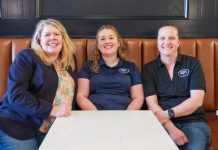
New hires signal continued investment in data-driven decision making across feed mills and protein production
March 2026 | Swine Web News Desk
As the swine and broader livestock industries continue to push toward greater efficiency and precision, the feed supply chain is emerging as one of the most critical areas for innovation.
BinSentry, a global ag-tech company focused on feed inventory and supply chain visibility, has announced the addition of two senior leaders to support its next phase of growth:

Tim Karl as Vice President of Milling
and Eric Adamson as Vice President of Product.

The appointments come at a time when producers and integrators are increasingly looking for ways to reduce inefficiencies, improve safety, and make more informed decisions in real time.
A Shift Away from Reactive Feed Management
For decades, feed management across the industry has operated in a largely reactive environment—characterized by manual bin checks, last-minute ordering, and limited visibility into inventory levels.
That model is now being challenged.
“With the scale we’ve reached—monitoring over 55,000 bins across North America—we’re seeing a clear shift toward more proactive, data-driven decision making,” said Ben Allen, CEO of BinSentry. “Tim and Eric bring the expertise to help accelerate that transition, particularly as we expand our capabilities within feed milling and supply chain coordination.”
Strengthening the Milling Side of the Business
Karl brings more than two decades of experience working with leading agribusinesses, including Cargill and Alltech, with a focus on operational performance and growth.
His role will center on helping feed mills transition away from traditional, manual processes toward systems built on real-time data.
“Historically, the supply chain has been driven by same-day decisions and emergency responses,” Karl noted. “That creates inefficiencies—from ingredient shortages to poor trucking logistics and procurement challenges.”
The shift toward real-time monitoring and improved forecasting is enabling a different approach—one where feed mills can operate with greater visibility and planning horizons, reducing both cost and risk.
Technology Driving Visibility and Control
At the core of this evolution is the increasing use of sensor-based technology and software platforms that provide accurate, real-time inventory data.
By eliminating the need for manual bin checks and reducing the risk of feed outages, these systems are helping producers and feed suppliers:
- Improve forecasting and ordering accuracy
- Reduce waste and unnecessary deliveries
- Enhance employee safety by minimizing bin climbing
- Create more stable and predictable supply chains
Product Innovation and Long-Term Vision
Adamson, a former ag-tech founder and advisor to Fortune 500 companies, joins BinSentry with a focus on product development and long-term innovation.
Prior to joining the company, he co-founded Tortuga AgTech, a robotics company focused on automated harvesting, which was acquired in 2025.
“What attracted me to BinSentry is the ability to solve real, everyday challenges at scale,” Adamson said. “There’s a clear opportunity to bring more intelligence and automation into the feed supply chain, and to help customers make better decisions with better data.”
His focus will include expanding the platform’s capabilities over the next three to five years, with an emphasis on improving customer experience and delivering measurable value across operations.
A Broader Industry Trend
The leadership expansion reflects a larger shift happening across the livestock industry—where data, automation, and real-time visibility are becoming essential tools rather than optional upgrades.
For swine producers and integrators, feed remains one of the largest input costs and one of the most critical operational variables.
As a result, technologies that improve feed management are not just about convenience—they are increasingly tied to:
- Profitability
- Animal performance
- Labor efficiency
- Risk management
Bottom Line:
As the industry moves away from reactive systems toward real-time, data-driven operations, companies like BinSentry are positioning themselves at the center of a more efficient and connected feed supply chain.