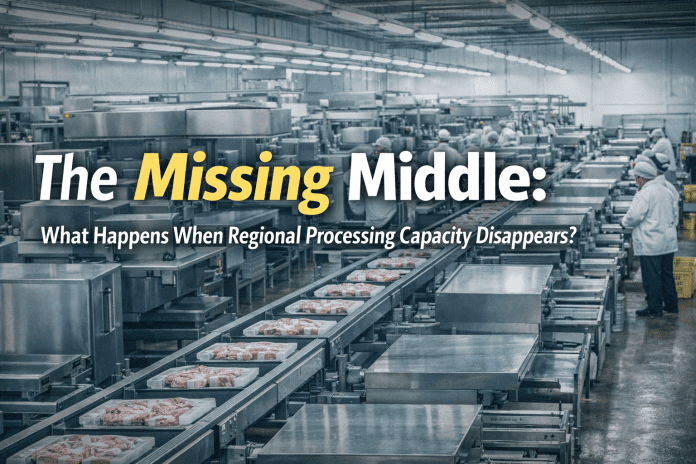
The pork industry has spent decades optimizing for efficiency, scale, and throughput.
But not necessarily for resilience.
And increasingly, that gap is starting to show.
While large-scale processing plants dominate production, a quieter shift is happening beneath the surface — small and mid-sized processors are under growing pressure, and in some cases, disappearing altogether.
This isn’t just a local issue.
It’s a structural one.
Beyond the Local Story
Regional processors have long played a critical role in the pork supply chain.
They provide:
-
Flexible harvesting options for independent producers
-
Custom processing for niche and value-added programs
-
Critical backup capacity during times of disruption
They are, in many ways, the connective tissue between production and market access.
But unlike large packers, these operations often run with tighter margins, smaller teams, and less ability to absorb volatility.
And in today’s environment, that pressure is building.
The Economics Are Tight — and Getting Tighter
Operating a small or mid-sized processing facility has never been easy.
Now, it’s becoming increasingly difficult.
Processors are navigating:
-
Rising labor costs with fewer skilled workers available
-
Increased regulatory and food safety requirements
-
Energy and operating cost volatility
-
Competition from vertically integrated, large-scale systems
At the same time, consumer demand for “local” meat — while strong in sentiment — can be inconsistent in practice.
The result is a widening gap between demand and sustainable economics.
Labor: The Hidden Constraint
One of the most significant and often overlooked challenges is workforce.
Processing is a skilled trade — and that skillset is becoming harder to find.
Experienced meat cutters are aging out of the workforce, and fewer young workers are entering the field. This creates:
-
Bottlenecks in processing capacity
-
Reduced operational efficiency
-
Increased strain on existing teams
Without a clear pipeline of skilled labor, maintaining — let alone expanding — regional capacity becomes a serious challenge.
Real-World Signals Across the Industry
This pressure isn’t isolated — it’s showing up across the broader protein landscape.
Alternative models, like those built around networks of independent producers and regional processors, continue to demonstrate the value of decentralized systems. At the same time, industry consolidation continues to concentrate processing capacity into fewer, larger facilities.
In Canada and the U.S., regional plants have proven essential during periods of disruption — but many continue to face the same challenges of labor, margin, and scalability.
The signal is consistent: the middle layer of the supply chain is under strain.
Why This Matters to Pork Producers
For producers — especially independent operations — regional processors provide more than convenience.
They provide:
-
Market access outside of large packer systems
-
Flexibility in timing and production flow
-
Opportunities for direct-to-consumer or branded programs
When that capacity tightens, options shrink.
And with fewer options comes less leverage — operationally and economically.
The Bigger Risk: Losing Flexibility
The industry has become exceptionally good at scale.
But scale comes with trade-offs.
When disruption occurs — whether from disease events, labor shortages, or plant shutdowns — smaller processors often act as the buffer that keeps the system moving.
If that layer continues to erode, the system becomes:
-
More concentrated
-
Less flexible
-
More vulnerable to shocks
Swine Web Insight
This isn’t about choosing between large-scale and small-scale processing.
It’s about balance.
The long-term strength of the pork industry may depend on maintaining a mix of:
-
High-efficiency, high-throughput plants
-
Regional, flexible processing capacity
Because resilience doesn’t come from scale alone — it comes from optionality.
Bottom Line
Small and mid-sized processors may not drive the majority of pork volume, but they play a critical role in the system.
As pressure builds, the question isn’t just whether they can survive — it’s whether the industry can afford to lose them.