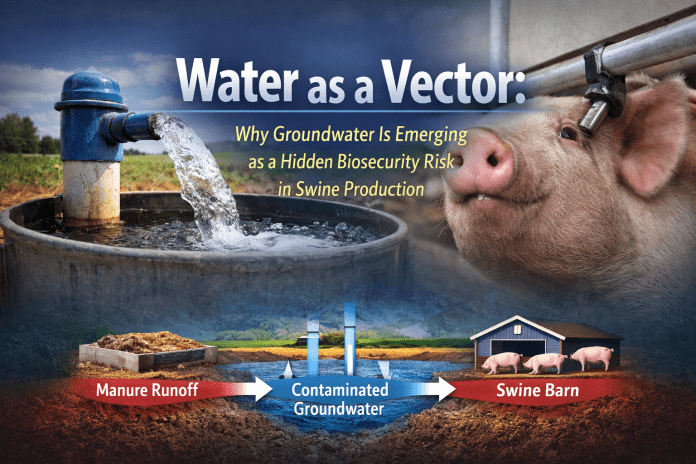
For years, biosecurity in swine production has focused on what we can see and control—people, transportation, equipment, and animal movement.
But a growing body of research is pointing to something far less visible… and potentially just as important.
Water.
More specifically, groundwater is beginning to emerge as an underrecognized pathway for pathogen movement, raising new questions about how disease pressure enters and circulates within modern production systems.
A Shift in How We Think About Risk
Recent research highlighted through the Leman Swine Conference and supported by work from the U.S. Geological Survey and Iowa State University is challenging long-held assumptions.
The core insight is simple—but significant:
Pathogens originating from manure and environmental sources can move through soil and reach groundwater systems that supply swine barns.
This is not just theoretical.
Studies have shown that bacteria, viruses, and protozoa can travel through soil layers via natural channels, particularly under conditions where rainfall or manure application creates movement through the soil profile.
In other words, what happens on the surface doesn’t always stay on the surface.
Understanding the Mechanism: How Pathogens Move
To understand why this matters, it’s important to look at how pathogens can physically move from manure to water sources.
Research has demonstrated several key pathways:
-
Soil macropores and cracks allow rapid downward movement
-
Rainfall events can accelerate leaching into drainage and groundwater
-
Certain pathogens, including viruses like PRRSV, have shown the ability to percolate through multiple soil types
-
Microorganisms can appear in drainage water within 24 hours of manure application
These findings reinforce a critical point:
Groundwater is not isolated—it is connected to surface activity in ways that are still being fully understood.
Beyond Swine: A Broader Livestock Signal
While the recent attention has focused on swine systems, similar findings have been documented across livestock sectors.
Groundwater near animal production sites has shown the presence of:
-
Salmonella
-
E. coli
-
Antibiotic resistance genes
This suggests that waterborne pathogen movement is not species-specific—it’s a systems-level issue tied to how we manage manure, land, and water together.
From Source to System: Why This Matters Inside the Barn
The implications go beyond environmental science.
Once pathogens enter a water source, they don’t just stay there.
They can:
-
Move into drinking water systems
-
Establish within biofilms inside water lines
-
Contribute to ongoing disease pressure at the barn level
This creates a potential loop:
Environmental contamination → groundwater → water system → animal exposure
And unlike traditional biosecurity risks, this pathway is difficult to detect without intentional monitoring.
A New Layer of Biosecurity Thinking
What this research ultimately suggests is not panic—but perspective.
Water may represent a missing layer in how we think about biosecurity.
As production systems continue to scale and optimize, controlling variability becomes increasingly important. And in many systems, variability is driven by factors that are not always visible or directly managed.
Groundwater fits into that category.
What Comes Next for Producers and the Industry
This is still an emerging area of research, but it opens the door to new considerations:
-
Should water sources be tested more routinely for biological risk—not just minerals and quality?
-
How does manure management strategy influence downstream water exposure?
-
Are there opportunities to improve water treatment, filtration, or line management inside barns?
-
Could groundwater variability help explain unexplained health challenges in some systems?
These are not fully answered questions—but they are increasingly relevant ones.
The Bigger Picture
The industry has made significant strides in biosecurity over the past two decades, reducing risk through better protocols, design, and discipline.
But as we continue to refine systems, the next gains may come from identifying the less obvious variables—the ones that sit just outside traditional control points.
Water may be one of them.
And as more data emerges, it may shift from being an afterthought… to becoming a central part of the biosecurity conversation.